AI demand forecasting in bakery: 30% less waste in 2026
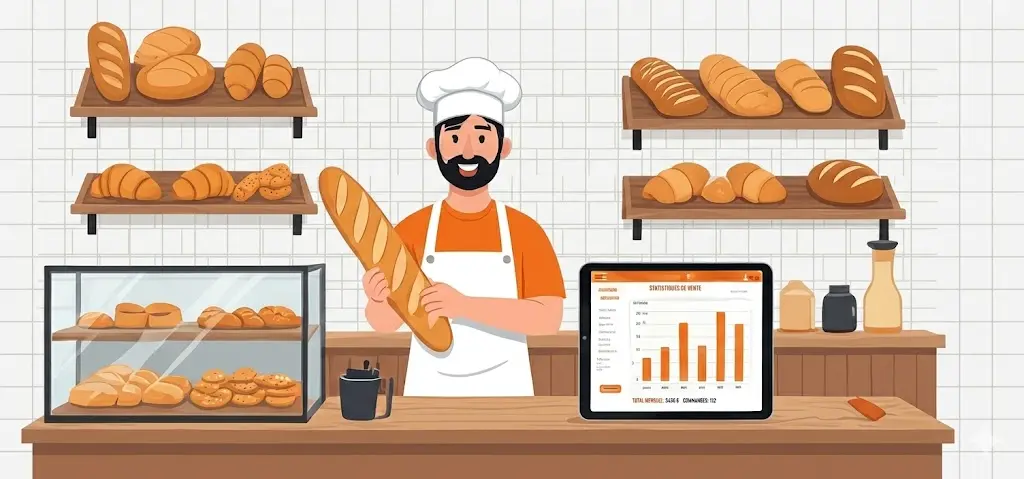
In 2026, AI demand forecasting software cuts unsold inventory in independent bakeries by 20 to 35 percent, with a 30- to 90-day payback and entry pricing between $55 and $215 per month depending on the tool. The algorithms cross POS history, local weather, school calendars, events, and seasonality to produce a daily, item-level recommendation for the next morning. What used to be a chain-only feature two years ago is now within reach for single-shop artisans.
The bakery sector wastes about 36 percent of what it produces, per <a href="https://www.dfki.de/en/web/news/ai-based-forecasts-for-food-production" target="_blank" rel="noopener noreferrer">Germany's DFKI research center</a>. That's roughly 75,000 tonnes of preventable bread waste per year in the UK and 150,000 tonnes in France. A mid-sized artisan bakery loses between $5,500 and $8,500 per year on unsold items, and one in four French bakeries finished 2024 in the red according to the joint <a href="https://www.lequotidiendesentreprises.fr/secteurs/alimentation/une-boulangerie-sur-quatre-deficitaire/" target="_blank" rel="noopener noreferrer">FEB and Banque de France study</a> (May 2026, in French).
The arrival of SaaS tools like Inpulse, Foodforecast, BakeOnyx, or Helean doesn't fully explain the tipping point. Three pressures converge: margin erosion, tighter EU anti-waste legislation, and model maturity. This article cuts through the marketing to explain what a baker can realistically expect from an AI forecasting tool, how to pick one, and how to plug it in without breaking the craft.
Why 2026 is the tipping point
Three pressures have been compounding for eighteen months, and they now push artisan bakeries to industrialize day-to-day decisions.
First, margins. The FEB and Banque de France study published in May 2026, covering 671 European bakeries between 2018 and 2024, shows a net profit of $3 to $4 per $100 of revenue in the bakery-viennoiserie-pastry sector, against $6 to $8 in the rest of food manufacturing. Out of every $100 cashed, $76 go straight back to ingredients, energy, and goods. Mechanically, there's very little left to absorb a rainy Monday or an overestimated pastry batch. Our piece on <a href="/blog/calculate-real-margins">calculating real bakery margins</a> walks through that ratio.
Second, regulation. Since January 1, 2025, French bakeries pay an AGEC eco-contribution of €0.0075 (≈$0.008) per checkout transaction, about €750 (≈$800) a year for 100,000 tickets per <a href="https://mae-innovation.com/en/packaging-tax-in-bakeries-whats-changing/" target="_blank" rel="noopener noreferrer">Mae Innovation</a>. Starting in 2026, the reporting tightens: stricter declarations of unsold volumes, valorization routes, and disposal channels, with administrative penalties up to €30,000 (≈$32,000) and another €7,500 per undeclared tonne. The UK is watching the French model closely as a regulatory template. Keeping a credible waste register isn't an ESG topic anymore; it's accounting.
Third, technology maturity. Inpulse has been live since 2018, Foodforecast since 2022, Helean rolled out across French chain Ange in 2023 and now equips 180 of the chain's 290 outlets per <a href="https://www.lefigaro.fr/societes/c-est-un-outil-fiable-et-confortable-comment-l-ia-aide-au-quotidien-les-boulangeries-ange-20250428" target="_blank" rel="noopener noreferrer">Le Figaro</a>. Foodforecast's published results across 5,000 European stores: up to 34 percent less waste and 11 percent more revenue from better availability.
The baker who keeps delaying isn't making a neutral choice. They're accepting to keep losing — in margin and in compliance — what their equipped neighbors recover.
How AI predicts what a bakery will sell tomorrow
An AI forecasting engine for bakeries works in three stacked layers.
The first layer is historical sales pulled from your POS, ideally six to twelve months for a sound start and at least two full seasons to hit realistic accuracy. By far the most decisive data point: without it, no model produces a credible recommendation.
The second layer is external factors the software fetches via APIs: 7- to 14-day weather, public holidays, school breaks by region, local events (festivals, markets, sports), sometimes Google Maps foot traffic on nearby businesses. Helean engineers say they wire in the Lorient Interceltic Festival or the Olympics into their training data. Accuracy climbs because the model learns to correlate a 40 percent croissant spike on a rainy Saturday with a specific signal, not a flat average.
The third layer turns that signal into an actionable recommendation. The system doesn't say "you'll sell about 120 baguettes." It says "bake 38 croissants by 5 a.m., run a second batch if sales pass 22 by 9 a.m., prep 95 lunch sandwiches." The <a href="https://www.larevuedudigital.com/la-biscuiterie-jeannette-sappuie-sur-lia-pour-fiabiliser-ses-previsions/" target="_blank" rel="noopener noreferrer">Biscuiterie Jeannette case</a>, running Renovatio from Rman Sync since 2025, posts 96 percent forecast accuracy on madeleines and a 20 percent food-waste reduction in under a year. Brioche Dorée is rolling out similar targets across 250 outlets.
A question keeps coming up: how many months of POS data do I really need? The honest answer is that useful recommendations show up in two to four weeks, but accuracy stabilizes around the sixth month, once the model has seen a full seasonal cycle. The realistic error margin once trained: ±8 to 12 percent on total daily revenue and ±10 to 15 percent on flagship items. For promotional or strongly seasonal items, doing better than ±20 percent is out of reach — worth knowing before you sign. Our guide on <a href="/blog/seasonal-production-planning">seasonal production planning</a> covers the manual overrides to apply.
Five criteria to pick the right AI forecasting tool
Rather than a comparison table that goes stale in six months, here's the decision grid that separates serious tools from 2026 marketing.
First, native POS integration. If the software doesn't pull tickets automatically, you'll spend five hours a month exporting CSV, and you'll quit after eight weeks. Inpulse, Foodforecast, and GoNina connect to HS Soft, ProtecData, Lightspeed, and several European POS systems. Helean is wired into Ange's stack. Real compatibility with your hardware has to be verified before signing.
Second, included external data. A vendor that asks you to type in weather or school holidays by hand isn't really doing predictive AI: they're selling a fancy spreadsheet. Serious solutions automatically pull OpenWeather, the national holiday calendar, regional school breaks, and local events within at least 5 kilometers. Check whether it's included or billed as an add-on.
Third, output granularity. A "total revenue" forecast doesn't help you adjust a batch. You want a count of baguettes, specialty breads, pastries, and sandwiches per production slot. <a href="https://www.inpulse.ai/blog/logiciel-de-gestion-des-stocks-en-boulangerie-reduire-le-gaspillage-et-augmenter-sa-marge" target="_blank" rel="noopener noreferrer">Inpulse</a> talks about hourly-slot forecasts; Helean delivers two-week rolling forecasts at the item level. Ask for a demo on your real SKUs, not a generic case.
Fourth, continuous learning. The software has to absorb your overrides when you decide to bake more than the recommendation for a local event. If it doesn't recalibrate, you're paying for a frozen model. The <a href="https://www.francenum.gouv.fr/guides-et-conseils/intelligence-artificielle/analyse-et-exploitation-des-donnees-metiers-avec-lia-4" target="_blank" rel="noopener noreferrer">France Num methodology</a> (in French) stresses the same point: a simple, measurable use case you document to iterate. Our piece on <a href="/blog/reduce-stock-loss">reducing stock loss</a> outlines the tracking template to set up in week one.
Fifth, cost relative to your size. A single-shop artisan doesn't need a $16,000 to $43,000 consulting sprint, the kind firms like Echelon Advising propose to chains. POS-integrated AI modules typically cost $55 to $215 per month for a single bakery, up to $540 for two or three outlets. Inpulse, Foodforecast, and GoNina openly target the artisan segment across France, Germany, and Switzerland, with transparent pricing online.
The Fournil angle: integrated forecasting or isolated AI module
Predictive AI is the visible part. The part that actually transforms profitability is its connection to the rest of the bakery.
A standalone AI module gives you a forecast. You're then on your own to enter the supplier order, adjust the production sheet, calculate theoretical food cost, and fill out the waste register. An integrated system links the forecast to the three subsystems that depend on it: stock, product margin, and compliance. When the forecast engine outputs 38 croissants, the stock module auto-deducts 1.9 kg of laminated dough and alerts you if AOP butter drops below the threshold. The croissant's gross margin recalculates in real time against today's butter price. End-of-service unsold items feed the bio-waste register you'll need at the next AGEC audit.
That's the Fournil philosophy. The platform consolidates POS sales, ingredient stock, batch-level production, and product margins in one database, with an AI forecasting module that consumes those data feeds instead of running in parallel. On $32,000 to $54,000 monthly revenue, the gap between a 20 and 35 percent waste reduction means $6,400 to $18,000 saved every month, per <a href="https://infinitysky.ai/blog/ai-automation-bakeries-food-production-2026" target="_blank" rel="noopener noreferrer">Infinity Sky AI</a>. For a single artisan, that's the equivalent of a thirteenth-month bonus; for a five-shop network, it funds an operations manager role.
AI doesn't replace the head baker. It replaces the sticky note on the oven and the eyeballed estimate that's worked for thirty years. Two different tools: product knowledge stays human, multi-factor statistical projection is now industrial. The goal isn't to take the decision away, but to make it with information no single brain can process alone. See <a href="/#features">the full Fournil module list</a> for details.
Key takeaways
The bakery-viennoiserie-pastry sector wastes 36 percent of its output on average per DFKI research, roughly 150,000 tonnes of bread per year in France and 75,000 tonnes in the UK. A mid-sized artisan bakery faces an annual unsold-product bill of $5,500 to $8,500.
AI demand forecasting tools cut that waste by 20 to 35 percent on average, with published cases at -34 percent (Foodforecast across 5,000 stores) and -20 percent (Biscuiterie Jeannette via Rman Sync). Payback runs 30 to 90 days for an entry cost of $55 to $215 per month on a single location.
AI works by triangulating POS history, external factors (weather, holidays, events), and a continuous learning model. Six to twelve months of POS data are needed to train a stable model. Useful recommendations land in two to four weeks; accuracy stabilizes by month six.
France's tightening AGEC anti-waste law in 2026 makes automated waste tracking effectively mandatory: an eco-contribution of €0.0075 (≈$0.008) per transaction and administrative penalties up to €30,000 (≈$32,000), plus €7,500 per undeclared tonne. A forecasting tool wired to a bio-waste register becomes a compliance investment, not just an optimization tool.
The most discriminating criterion between tools isn't the advertised accuracy, but native integration with the POS and ingredient stock. A standalone AI module stays a dashboard; an integrated AI module becomes a piloting system. See our piece on <a href="/blog/reduce-stock-loss">reducing stock loss</a> for the operational template.
Conclusion
In 2026, AI demand forecasting is no longer the innovation topic to pilot. It's now part of the standard toolkit of a professionally run bakery, alongside the mixer and the recipe card. Ange has equipped two-thirds of its network, Brioche Dorée is rolling out across 250 outlets, Foodforecast runs in 5,000 European stores. The question isn't "should I go" but "with which tool and at what pace."
The most frequent mistake is buying the standalone AI module and discovering six months later that the recommendations are connected to nothing. An integrated platform that talks to POS, stock, production, margin, and the AGEC register almost always beats a stack of four pieces of software that don't sync. That integration is what separates a 5 percent waste reduction from a 30 percent one.
For more, read our analysis on <a href="/blog/calculate-real-margins">real bakery margins</a> or check the <a href="/#pricing">Fournil pricing page</a>.