Bakery Staff Shortage in 2026: Automate to Save 10 Hours a Week
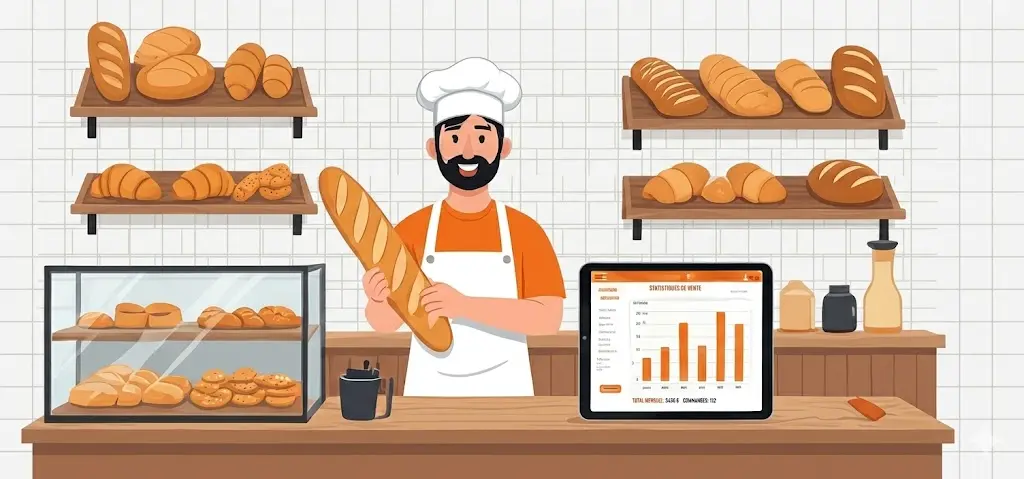
The fastest answer to the 2026 bakery staff shortage isn't to hire at any cost — it's to automate the repetitive management tasks (POS, stock, scheduling, reports) and give the bakers already there 6 to 10 hours of weekly capacity back. That shift keeps production steady without an immediate hire and strengthens retention by cutting mental load, not just upping wages.
The artisan bakery sector faces a structural workforce crisis on both sides of the Atlantic. The American Bakers Association projects 53,500 unfilled bakery jobs in the US by 2030. France's CNBPF reports 9,000 vacancies across 33,000 artisan bakeries. Baking Business's March 2026 survey found 41 % of bakers rank finding and keeping quality staff as their biggest business challenge for the next 12 to 18 months. Labor costs keep rising — wage costs in bakery manufacturing climbed 13 % in 2025 per the FCC 2026 Food and Beverage Report.
More retail bakery operators are choosing targeted software automation: not to replace bakers, but to unload the dozens of micro-admin tasks that eat the day. This article covers the latest workforce data, four concrete automation levers (POS, scheduling, stock alerts, financial reporting), and how a bakery management platform like Fournil makes those gains real without heavy hardware.
Bakery Staff Shortage in 2026: What the Numbers Say
The American Bakers Association forecasts 53,500 unfilled bakery positions in the US by 2030. France's CNBPF reports 9,000 open positions today across 33,000 artisan bakeries. In the UK, 64 % of food manufacturers told the Food and Drink Federation in Q4 2024 that workforce efficiency — not headcount expansion — drives their main investment, detailed in <a href="https://howtorobot.com/expert-insight/bakery-robots-how-automation-solving-bakery-production-challenges" target="_blank" rel="noopener noreferrer">a 2026 industry analysis</a>. Same pattern across markets: fewer young workers entering the trade, higher turnover, wage costs that retail margins can't absorb forever.
Apprenticeship subsidies still help in some markets. France reactivated its exceptional apprenticeship aid via Decree 2026-220 of March 6, 2026, capping the net cost of a CAP Boulanger apprentice at roughly €393/month (≈ $420). In the US, Retail Bakers of America programs and state workforce boards offer tax credits, no monthly subsidy equivalent. Either way, the bottleneck is upstream: the candidate pool is shrinking, and a March 2026 Bakery and Snacks report warned <a href="https://www.bakeryandsnacks.com/Article/2026/02/17/bakery-automation-stalls-amid-skills-gap/" target="_blank" rel="noopener noreferrer">automation alone won't close the skills gap</a> without parallel training.
Two forces compound: 25 % of French bakery apprenticeship contracts break in the first year, and US retail bakery turnover runs around 75 % annually for front-of-house roles. Each replacement runs 50 to 60 days of salary in direct and indirect costs (recruiting, training, lost productivity). For a 6-to-10-person bakery, two breakdowns per year cost the equivalent of a half-time position. Late-night and weekend shifts plus the physical strain explain most early exits — structural factors a $50/month bump won't fix on its own. For team structure, see <a href="/blog/manage-team-roles">How to manage a 10-person bakery team with clear roles</a>.
Four Automation Levers That Free Up 10 Hours a Week
Start with a smart point of sale that debits stock automatically. A modern POS subtracts ingredients from inventory at every ticket via recipe sheets, killing the daily double entry into a notebook or spreadsheet. For a bakery handling 200 to 400 tickets a day, the time saved on manual stock tracking and end-of-day reconciliation runs 1.5 to 2 hours daily — 9 to 12 hours per week. <a href="https://www.echelon-advising.com/insights/ai-for-bakeries-food-production" target="_blank" rel="noopener noreferrer">An April 2026 industry analysis</a> shows that bakeries automating inventory and production planning together cut food waste by 20 to 30 % and manual planning time by 40 %.
Next comes digital staff scheduling. Building the weekly schedule for a 6-to-12-person bakery on a spreadsheet eats 1 to 2 hours of owner time, plus daily fixes for sick days, vacation requests, and shift swaps. A scheduling module lets you enter constraints once (roles, days off, mandatory rest) and auto-generates compliant rotations. Net gain: 1 to 1.5 hours per week of owner time, plus fewer last-minute scrambles.
Minimum-stock alerts and supplier order automation come third. Instead of checking flour, butter, yeast, and egg levels every morning on a paper sheet, the system pings the owner when a threshold is crossed and proposes a draft order to the usual supplier. The baker validates or adjusts in 30 seconds, no walk to the storage room. For a bakery tracking thirty-odd key ingredients, that's 2 hours per week saved, and the risk of running out mid-production drops sharply. Tools <a href="https://smbai.guide/guides/bakery" target="_blank" rel="noopener noreferrer">indexed in SmbAI's 2026 bakery guide</a> show typical cumulative savings of 12 to 18 hours per week within 30 days of implementation.
That leaves automated financial reporting. Computing weekly revenue by product family, gross margin, shrinkage rate, and food-cost ratios manually on a spreadsheet eats 4 to 8 hours, plus the monthly accountant prep. Auto-extracted reports drawn from sales and supplier invoices erase almost all of that. The gap between manual and integrated margin calculation is often material — see <a href="/blog/calculate-real-margins">How to calculate your real bakery margins</a> for the common biases. Across the four levers, realistic savings land between 6 and 10 hours per week — a quarter of a full-time position handed back to the bakers on staff.
How Fournil Makes These Levers Accessible to Artisan Bakers
<a href="/#features">Fournil</a> targets retail artisan bakeries that want to automate management without changing hardware or hiring an IT vendor. The POS module runs on tablets and phones, offline-first — sales keep going during internet outages, which happen more often than anyone admits in a basement bakery. Sync resumes the moment connectivity returns. Stock debits via recipe sheets are automatic: each loaf sold subtracts the flour, salt, yeast, and water defined in the recipe entered once.
The scheduling module covers roles, contracts, overtime, and rest days, respecting local labor rules. Front-of-house staff see their schedule on their phones, request time off in two taps, and the owner approves or denies from any device. Last-minute changes (sick day, shift swap) propagate to the whole team automatically, no phone calls. That workflow is what gets bakery owners out of the "indispensable manager" trap — see our case study <a href="/blog/notebook-to-digital">From paper notebook to digital: a successful transition</a>.
Minimum-stock alerts and financial reports activate in minutes during initial setup. The dashboard shows real-time daily revenue, margin by product family, ingredients at critical thresholds, and shrinkage drift versus the prior week. For multi-site groups or franchises, Fournil isolates each location's data while offering a consolidated head-office view. History-based production planning (see <a href="/blog/seasonal-production-planning">Plan your seasonal bakery production</a>) closes the loop on the production side, suggesting nightly dough quantities for the next morning. Pricing tiers sit on the <a href="/#pricing">pricing</a> page; the typical investment pays for itself in under 90 days on admin time savings alone.
Key Takeaways
53,500 US bakery positions projected unfilled by 2030 (American Bakers Association). 9,000 already vacant across 33,000 French artisan bakeries (CNBPF). Workforce gaps are structural now, not cyclical. Waiting for them to resolve themselves is not a strategy.
Bakery wage costs rose 13 % in 2025 (FCC 2026 Food and Beverage Report) while retail margins stayed thin (food cost 28 to 35 %, net profit 5 to 15 % per BakeOnyx 2026 benchmarks). Wage inflation can't pass through to customers forever. Productivity per hour worked has to rise.
25 % of French apprenticeship contracts in bakery-pastry break in the first year. US retail bakery turnover runs around 75 % annually for front-of-house roles. Replacement cost averages 50 to 60 days of salary per exit. Retention through workload reduction (automation of admin tasks) often beats small wage bumps.
Four immediate levers — POS with automatic stock debits, digital scheduling, minimum-stock alerts, automated financial reports — together free up 6 to 10 hours per week, a 0.2 FTE handed back to the team without hiring.
ROI on a bakery management platform like Fournil typically lands in under 90 days for a mid-sized retail bakery, on admin time savings alone. On top, automation cuts food waste by 20 to 30 % per 2026 industry data — gross-margin gain that compounds with the time gain.
Conclusion
The 53,500 unfilled US bakery jobs and 9,000 unfilled French positions are structural, not a cyclical blip. Each operator will live with that reality for the next five to ten years. Hiring still matters — patient work over 18 to 36 months: onboarding apprentices, mentoring, retention, competitive pay. In the short term, targeted software automation of POS, scheduling, stock alerts, and reporting delivers 6 to 10 hours of weekly capacity from month one, no hardware overhaul, no organizational disruption.
The bakeries that combine a patient hiring strategy with aggressive software automation today are the ones getting through the next winters without closing one day a week for short staffing. Fournil delivers a unified platform that automates the four levers covered here, no hardware swap, no multi-week training.