How to Manage a Team of 10 with Clear Roles
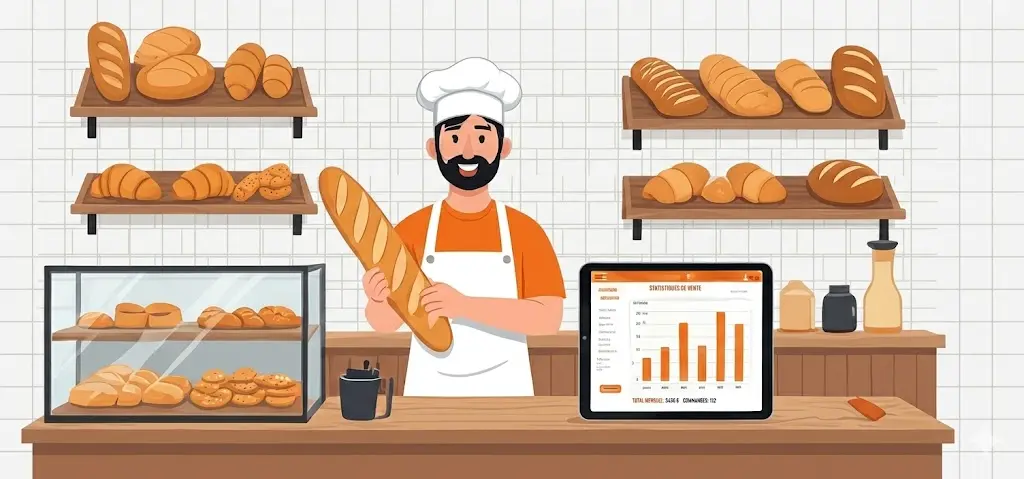
Clear role definition is the most underinvested management lever in artisan bakeries — and the one with the highest leverage for operations that have grown beyond a small founding team. Going from 3 to 10 employees is not simply adding more people doing the same things: it is a qualitative shift in how information flows, how decisions are made, and how accountability is distributed. What worked when the owner and two trusted colleagues could coordinate through daily conversation becomes a source of chronic friction, duplication and operational error as the team scales.
The questions become structural rather than situational: Who is responsible for the supplier order this morning — not who happens to do it, but who owns it as their defined responsibility? Who closes up tonight and what does closing actually require? Who is authorised to modify a recipe or adjust a selling price? Structuring roles and responsibilities is not bureaucracy — it is the operational precondition for a business that can function without the owner being simultaneously present in the bakehouse, the shop, the office and the supplier's loading bay. The artisan bakery sector employs around 180,000 people across France's 33,000 artisan establishments. Those that grow sustainably beyond 5 employees do so by building systems that work without constant owner intervention — and clear role definition is the foundation of those systems.
Common team management challenges in bakeries
The first challenge is the breakdown of informal communication as team size increases. In a team of 3 or 4, verbal coordination works: 'Don't forget to order the yeast today' or 'We need 50 extra baguettes tomorrow for the school catering order'. The team is small enough that everyone is present for most conversations, context is shared automatically, and nothing important falls through the gaps. But at 10 people, split across different shifts (the production team starting at 3am, the shop team arriving at 7am, the delivery driver leaving at 9am), verbal coordination becomes a game of telephone. Critical information — a special order for Saturday, a change in the weekly delivery schedule, an ingredient that is approaching its use-by date — moves incompletely through the team. The result is missed orders, overproduced batches, and the recurring confusion that erodes both team morale and operational performance.
The second challenge is the absence of defined responsibility boundaries. Without explicit role definitions and documented task ownership, every team member does a bit of everything and no one is specifically accountable for any particular outcome. This creates a predictable pattern: tasks with clear individual rewards (front-of-house customer interaction, creative production work) are done reliably and sometimes duplicated; tasks with diffuse benefit and individual effort (cleaning equipment between production runs, counting and recording end-of-day stock, restocking the window display after the morning rush) are systematically deferred in the expectation that someone else will do them. The <a href="https://www.bls.gov/ooh/food-preparation-and-serving/" target="_blank" rel="noopener noreferrer">BLS occupational guide for food preparation roles</a> identifies explicit task allocation as among the strongest predictors of both team efficiency and individual job satisfaction in commercial kitchen environments. According to CMA France (2023), 67% of artisans cite administrative and organisational management as their primary operational difficulty — and unclear role definition is the most commonly reported root cause.
The third challenge is the absence of operational traceability. Without a systematic record of who did what, when, and with what inputs and outputs, errors cannot be diagnosed and processes cannot be improved. When a catering order is delivered with the wrong quantity of a product, the question is not just 'who made the mistake?' but 'what broke in the process that allowed this to happen?' Was the order specification communicated incorrectly? Was the production sheet misread? Was the shaping weight inconsistent? Without traceability, these questions cannot be answered reliably, and the same errors repeat indefinitely. <a href="/blog/notebook-to-digital">Going digital</a> is typically the first step toward building the traceability that makes operational improvement possible.
Setting up clear roles and responsibilities
Begin by mapping the core operational functions that your bakery requires, independent of the specific people currently filling them. In most artisan bakeries of 8 to 12 people, these fall into four main categories: production (dough mixing and kneading, bulk fermentation management, shaping and scoring, proofing oversight, oven loading and management, finished goods handling and cool-down); sales (customer service, till operations, window display management and restocking, special order taking); management (supplier ordering, stock receiving and verification, accounts and financial reporting, compliance documentation); and maintenance (daily and deep cleaning, equipment maintenance scheduling, waste management). Each function must have a named responsible person — someone whose role explicitly includes ensuring this function runs correctly, even when they delegate specific tasks within it.
For each position, create a simple, practical task list that distinguishes between daily responsibilities, weekly tasks and monthly requirements. This is not a formal HR document or an employment contract — it is an operational reference that should be physically posted in the relevant workspace (the bakehouse, the shop counter area, the back office) where it can be consulted without interrupting anyone. The discipline of writing these lists typically surfaces both gaps (tasks that no one currently owns) and overlaps (tasks that multiple people believe they are responsible for, leading to duplication or conflict). The Institut National de la Boulangerie Pâtisserie recommends reviewing these operational documents quarterly as the business evolves in its product range, team structure and customer mix.
Establish two simple communication rituals that replace the dozens of informal micro-conversations that currently fragment the working day. A 5-minute morning briefing — ideally at the shift change between production and sales, typically around 7am — covers the day's production targets, any special orders to be filled, expected deliveries and staffing coverage. A 30-minute weekly review — ideally Monday morning before the week's main production — covers the previous week's sales performance, stock status, any supplier or quality issues, and upcoming commitments. These rituals create predictable moments for information to flow that do not depend on chance encounters or interruptions during active production.
Tools for planning, oversight and accountability
A shared scheduling tool is operationally essential once your team exceeds 5 people. Working hours, rest days, holiday schedules and shift cover arrangements must be visible to every team member at all times — not just the owner. The production team member who needs to arrange cover for a doctor's appointment, the shop assistant planning a family event, the delivery driver requesting a specific day off: all of these require a shared reference that everyone can consult and that reflects current reality rather than a version that was accurate 3 weeks ago. A physical whiteboard can work for very small teams but breaks down quickly at scale. A digital shared schedule — accessible from any smartphone — ensures that the relevant information is always current and always accessible.
Role-based access control is the digital tool feature that most directly supports the role clarity established by good organisational design. With <a href="/#features">Fournil</a>, each team member logs in with a personal account and sees only the information relevant to their defined role. The shop assistant sees the product catalogue, current stock levels and the till — not the margin rate reports or supplier pricing. The production baker sees recipes with precise ingredient quantities for each batch, current stock levels and the production schedule — not the financial summaries. The production manager sees all production data plus purchase orders and delivery schedules — but not the payroll or commercial margin analysis. You define these access boundaries once, and the system enforces them automatically. This is not about distrust — it is about ensuring that every team member has a clean, focused operational environment rather than access to a confusing mass of data that is not relevant to their role.
Action traceability is the feature that closes the accountability loop. Every operation in the system is timestamped and linked to the user account that performed it: which team member processed each sale, who received and signed off each supplier delivery, who modified a recipe formulation, who approved a change to a selling price. When an error occurs — and in any high-volume operation, errors will occur — traceability allows you to identify the specific point of failure and fix the process rather than assigning blame. This is also increasingly important for regulatory compliance: the <a href="https://www.economie.gouv.fr/entreprises/boulangerie-reglementation" target="_blank" rel="noopener noreferrer">regulatory standards for the artisan bakery sector</a> require documented ingredient traceability and production records, and digital tools that generate these records automatically reduce both compliance effort and compliance risk.
Key Takeaways
Scaling from 3 to 10 employees requires a fundamental shift from informal verbal coordination to structured, documented role assignment. What functions reliably at small scale creates chronic operational problems at larger scale: missed instructions, undefined accountability, undiagnosed error patterns.
The three systematic team management problems in artisan bakeries are communication breakdown (critical information lost in transit across shifts and roles), undefined responsibilities (popular tasks duplicated, unpopular tasks deferred), and absence of traceability (errors cannot be diagnosed, processes cannot be improved).
Role mapping should cover four core operational functions — production, sales, management and maintenance — with a named responsible person for each, even when team members hold multiple roles.
Simple operational task lists posted in each workspace, distinguishing daily, weekly and monthly responsibilities, are more effective for day-to-day management than formal HR documentation.
Role-based access control in digital tools enforces organisational boundaries automatically: each team member sees only what is relevant to their role, creating a clean operational environment while maintaining appropriate data security.
Action traceability (every operation timestamped and linked to a named user) enables process improvement rather than blame assignment when errors occur, and directly supports regulatory compliance requirements for ingredient traceability and production documentation.
Conclusion
Managing a team of 10 well does not require management training credentials — it requires structural clarity, consistent communication habits and tools designed for the operational environment. By mapping your core functions explicitly, assigning ownership unambiguously, establishing predictable communication rhythms and backing the whole system with a digital platform that enforces role boundaries and records every operational action, you transform team management from a daily source of friction into a genuine operational advantage.
<a href="/#features">Fournil</a> provides the technical layer for this structure: role-based user accounts, granular access permissions, shared scheduling, and full operational traceability. Focus on your craft — Fournil handles the team management infrastructure.