Why Going from Notebook to Digital Changes Everything
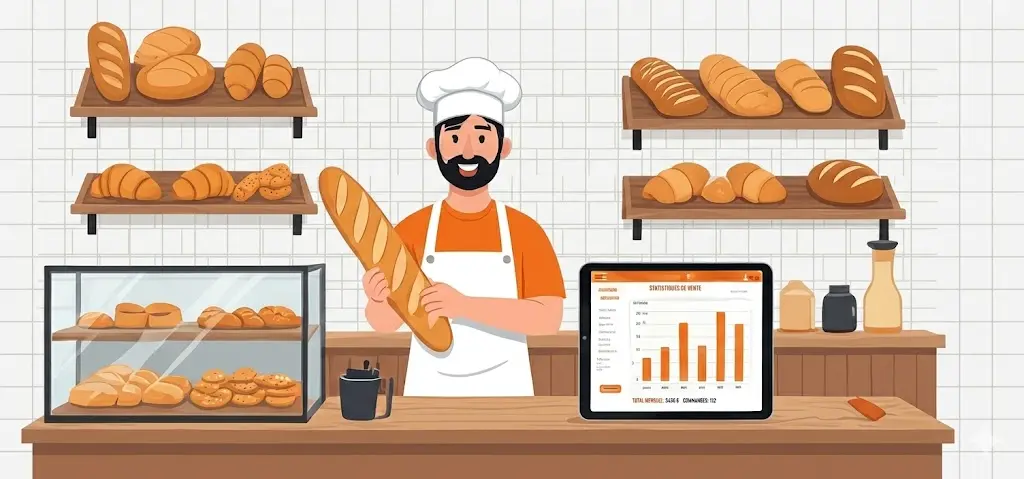
Switching from a paper notebook to a digital management system is the single operational change with the highest and most immediate return on investment for the majority of artisan bakeries — and it is also the change most consistently deferred because it feels disruptive. The notebook is a familiar and faithful tool. Orders, recipes, stock counts, accounts: for decades, everything in a well-run artisan bakery fitted in a ledger kept next to the till or on the worktop beside the oven. For a bakery of 2 to 3 people, that system worked.
But as businesses grow — more products, more employees, more regulatory requirements, higher sales volume — the limits of paper-based management become not just inconvenient but commercially damaging. A survey by CMA France (2023) found that 67% of artisans identify administrative management as their main operational difficulty, and the average artisan spends 8 to 10 hours per week on administrative tasks. In a sector where labour costs represent 35 to 45% of revenue, those 8 to 10 hours of expensive owner time being absorbed by manual data entry, stock counts and bookkeeping represent a significant and addressable cost. Going digital does not mean abandoning what works — it means replacing what does not.
The limits of paper-based management
The first structural problem with a notebook is the inevitability of human error. A figure copied incorrectly when transferring stock counts from a handwritten tally to a summary sheet. A total miscalculated when adding up daily ingredient usage. A supplier order forgotten because the page was turned before the note was written. These errors are not the result of carelessness — they are the predictable consequence of asking a person to be the sole data-processing layer in an information-intensive operation. According to industry professionals, a majority of artisan bakers have experienced at least one significant supplier ordering error linked to a transcription problem in the past year. In a sector where raw material costs represent 25 to 35% of revenue, ordering errors — too much, too little, wrong specification — directly erode the margin rate on every product affected.
The second problem is information loss and inaccessibility. A notebook absorbs spilled flour and coffee, deteriorates with daily handling, and can be lost or destroyed. It can only be consulted by one person at a time and from one location — the bakery. If your production manager needs to check a sourdough recipe while you are reviewing supplier orders at the same table, someone waits. If the notebook disappears — a common event in a busy working kitchen — months of accumulated data disappear with it: historical production quantities, ingredient cost records, customer order histories, the notes from the last quarterly price review. There is no backup, no version history, and no way to reconstruct what was lost. The absence of data continuity is a management risk that compounds year by year.
The third and most consequential limitation of paper is its total inability to support analysis. What is your best-selling product on Tuesday afternoons? How has your raw material cost per baguette evolved over the past 6 months? On which specific days of the week is your overproduction rate — and therefore your taux de freinte — consistently highest? Which products have a falling margin rate that you have not yet noticed? These questions are not optional management curiosities: they are the foundation of operational decisions about pricing, production planning, purchasing and staffing. Paper cannot answer any of them. The <a href="https://www.chambre-metiers.org/" target="_blank" rel="noopener noreferrer">Chambre des Métiers et de l'Artisanat</a> consistently identifies the absence of analytical data as the primary structural obstacle to profitability improvement in artisan businesses of all types.
What digital tools actually deliver
A management tool like Fournil centralises all your operational data — recipes with their full ingredient lists and raw material costs, stock levels with live updates from each sale, daily and weekly sales figures, margin rates by product and category, supplier order history — in a single system accessible from any screen. A tablet in the bakehouse for the production team. A phone for the delivery driver. A desktop in the office for end-of-week reporting. The same data, updated in real time, available to the right person at the right moment without anyone having to write it down, copy it across, or ask someone else.
Automatic reports transform raw operational data into actionable management information without the 8 to 10 weekly hours of manual compilation that drain owner time in paper-based operations. At a glance — a genuinely 5-minute review, not an hour-long spreadsheet session — you see your sales performance by product, your <a href="/blog/calculate-real-margins">net margins by category</a>, your weekly waste rate trends, your stock level status, and any threshold alerts requiring attention. As <a href="https://www.sba.gov/business-guide/manage-your-business" target="_blank" rel="noopener noreferrer">the SBA guide on business management</a> explains, centralising operational data is the essential precondition for fast, reliable decision-making at any business scale. The average French artisan bakery generates between €350,000 and €400,000 in revenue annually — managing that volume of transactions on handwritten records is not just inefficient, it is a structural risk.
<a href="/blog/manage-team-roles">Team coordination</a> becomes natural and systematic rather than dependent on the owner's presence and memory. Your production manager sees the quantities to produce for the day, drawn from historical sales data, before starting the first batch. Your shop assistant knows in real time which products are available from the production schedule, rather than having to physically check the display. Your accountant can pull the figures they need directly from the system without interrupting your working day. Everyone has the information they need, when they need it — and the 8 to 10 weekly administrative hours identified by CMA France (2023) compress dramatically, often to under 1 hour.
How to make the transition smoothly
The transition to digital management creates anxiety for many artisan bakers, most of whom have built their entire operational practice on paper. The concern is understandable: changing a system that works, even imperfectly, risks disrupting a business that runs on precise timing and accumulated habit. But a gradual, module-by-module transition approach removes the risk almost entirely. Rather than switching everything at once, start with a single operational area — stock tracking or the till — while keeping your notebook as a parallel backup for 2 to 3 weeks. Use this period to build familiarity with the interface, identify any gaps in your recipe data, and establish the input habits that the system depends on. Once you are comfortable with the first module, add a second. Typically, bakers reach full adoption within 4 to 8 weeks using this approach.
For data migration, resist the temptation to enter everything before going live. A complete data migration is a project that never gets started. Instead, begin with your 20 best-selling products — enter their recipes with precise ingredient quantities and raw material costs — and your 30 most frequently ordered ingredients with current supplier prices and reorder thresholds. This covers the operational core of most artisan bakeries. Additional recipes and ingredients can be entered over the following weeks as they arise naturally in production, without a dedicated migration effort. <a href="/#how-it-works">Fournil</a> supports CSV import from spreadsheets for bakeries that already maintain a digital recipe or stock record, which can reduce the initial setup time to a single afternoon.
Staff adoption is the most commonly cited concern and the least frequently realised problem. Modern bakery management software is designed to be operable by people with no technical background and no prior experience with digital tools. Most bakers working with Fournil report full team self-sufficiency within 3 to 5 days of introduction. The key success factor is early involvement: show your team the specific, concrete operational benefits — less manual counting, fewer ordering errors, no more end-of-day reconciliation — before expecting them to adopt new habits. Appointing a digital champion within the team (often the person most comfortable with smartphones) creates an internal resource that accelerates adoption without requiring ongoing owner involvement. See the <a href="https://www.inbp.com/" target="_blank" rel="noopener noreferrer">INBP's guidance on digital tools for artisan bakeries</a> for additional practical transition frameworks.
Key Takeaways
67% of artisans identify administrative management as their main operational difficulty; the average artisan spends 8 to 10 hours per week on admin tasks (CMA France, 2023). Digital tools typically reduce this to under 1 hour per week — a return on investment that is immediate and compounding.
Paper management creates three distinct categories of operational risk: human transcription errors (inevitable in a high-volume, time-pressured environment), information loss and inaccessibility (no backup, no multi-user access, no remote access), and analytical blindness (no ability to derive trends, identify waste patterns, or track margin evolution).
Digital tools centralise recipes, stock levels, sales data, margin calculations and team schedules in a single real-time system accessible from any device by any authorised team member.
A successful transition does not require replacing everything at once. Start with one module (stock or till), run it alongside your notebook for 2 to 3 weeks, then add modules progressively. Full adoption typically occurs within 4 to 8 weeks using this graduated approach.
Data migration need not be comprehensive to begin. Start with 20 core recipes and 30 main ingredients — enough to cover the operational heart of the bakery — and add the rest naturally over the following weeks as production requires.
Staff adoption is faster than most bakers expect: self-sufficiency within 3 to 5 days is typical when early benefits are communicated clearly and a digital champion is designated within the team.
Conclusion
Going from notebook to digital is not a technology investment for its own sake — it is a practical operational decision that pays for itself within weeks in time recovered, errors eliminated, and visibility gained. In a sector where net margins average 3 to 7%, the 8 to 10 weekly hours of manual admin that digital tools eliminate represent a meaningful share of the owner's working time and cognitive load.
Fournil was designed from the ground up for artisan bakers: the interface works in a bakery environment, the data model understands recipes, batches and production schedules, and the support team knows what a proofing rack is. Take the first step: try it for free and see the difference for yourself.